The Bible records God's wrath in numerous passages. Sometimes it is hard to reconcile what we commonly think of as "wrath" (anger, rage, or fury) with what we think of as a good God: kind, loving, and forgiving. But wrath can also refer to gentler feelings like displeasure, exasperation, or irritation. Indeed, the Bible teaches that God loves everyone, but he can also get very upset with us, both individually and together as the human race. It is easy to see how God might have such responses to many of the things humans do. See my theodicy 101 post for some general thoughts about the apparent discrepancy between his anger and love, but in this post I want to focus on one particular version of God's wrath, what it means and why it applies.
A longstanding and straightforward understanding of God's wrath is simply the natural consequences of going against God's will. Good parents will protect and love their children, but will also allow them to experience the consequences of their actions, both good and bad. If junior disobeys, then something "bad", from his perspective, happens to teach him that actions have consequences. This could be viewed, from junior's perspective, as the wrath of his parents. He may cry "unfair", or "you're mean" when a toy is taken away, or he is sent to a corner for a time out, or later when he is grounded for a week. Yet we understand that actions indeed have consequences, and parents need to discipline their children appropriately for them to learn and mature properly.
In some ways it is the same for us and God. If we are smokers, we should not blame God if we get lung cancer. If we turn our backs on his directives regarding our sexuality, instituted for our good, we should not complain to him if we get an STD, or if our relationships falls apart. If we are selfish, hard on others, deceitful, or otherwise behave poorly, we should expect consequences that work to our detriment: losing friends, being lied to in return, feeling cheated even when we are treated fairly, etc. In this way, much of God's wrath can be seen as the natural, or predictable results of our own actions or disobediences. Clearly, there is more to God's wrath than this, but this can be a good starting place. God gives us rules for our own good, and if we ignore them, we can expect unhappy results to follow.
Let's see how this plays out at a larger scale; for groups, nations and the entire world. For ancient Israel, God's wrath consisted of their nation being conquered by foreign armies and them taken into exile. This involved many deaths and cruelties: I won't pretend that these effects were one-on-one aligned with individual sins and personal disobediences, although there was doubtless some of that. No, in that case, God had often instructed, then berated and warned the people and their leaders against idolatry and injustice, but they kept falling back into sin and turning their back on God. Although slow to anger (hundreds of years), God eventually had enough and, for the nation's own good, destroyed their nation, and took them into exile in Babylon. Apparently they did learn that lesson and after their return to Israel, did not return to blatant idolatry.
Closer to here and now, let's look at modern Canada (or Europe, or the USA). Sixty or so years ago, Canada could reasonably have been called a Christian nation. Not everyone was Christian of course, but our laws, schooling, acceptable public behaviour, institutions, and mores were all based more or less on Judeo-Christian principles of truth, integrity, honesty, care for others, rule of law, fairness, etc. There were obviously glitches, and not everything was perfect, but most people honoured God to some extent and obeyed rules based largely on his precepts and commands.
Fast forward to the 21st century: now Biblical truths are unknown, derided, ignored, or put down as "oppression" or "bigotry" by many. Schools can teach anything except Christian values it seems, and can push ideologies directly counter to Christian doctrines. How many millions of God's highest and most innocent creatures do we deliberately kill off each year by abortion? And now we push for euthanasia, killing off those at the other end of life. Entertainment, the mass media, various government edicts and court decisions continue to pare away Godly influences, or undermine Biblical teachings, often promoting their opposites. Fewer people attend worship services, read the Bible, or even pray to God these days. If God smiled on Canada 60 years ago, is he still smiling, or has he begun to withdraw his blessings?
The ancient Hebrew blessing reads, "The Lord bless you and keep you; the Lord make His face shine on you and be gracious to you; the LORD lift up His countenance upon you, and give you peace." (Numbers 6:24-26). If a nation or people turns its back to God, ignoring him, or worse, denying his very existence and demeaning those who seek to follow his ways, can that nation expect God to lift His countenance upon us? C.S. Lewis wrote, "There are only two kinds of people in the end: those who say to God, "Thy will be done," and those to whom God says, in the end, "Thy will be done." When we don't listen to God, he in effect says, "OK, have it your way, along with the consequences that come with your choices".
What are those consequences? We don't have to look far. While our standard of living has risen since mid 20th century, has our level of happiness also increased? It seems more people are lonely and stressed than ever; we have higher personal and national debts, there are more demands on our time, rising mental health problems, and societal pressures abound. The list goes on. The sexual revolution of the 1960's was supposed to bring more freedoms, but instead brought diseases, abuse, broken and complicated families, insecure and anxious children, rampant divorce, the flood of abortion, sexually transmitted diseases, widespread loneliness, relationship headaches, and so on. We have growing wealth, but also pollution, inequality, underemployment, the rat race, heavy competition for jobs and promotions, rising anger and discontent. Politically, there are increasing deficits, taxes, political conflicts, distrust, suspicion, and polarization. Not many blessings in all that!
The picture is a bit less clear at the global level. Christianity, however defined, is the largest religion in the world, with over two billion adherents of one affiliation or other. In a global population around eight billion, Christians are still a minority. The faith is growing in some places, but retreating in others. Moreover, there is a growing hatred of Christianity world wide. Communism still holds in some countries, with its atheist biases and the oppression of churches and free expression. Islam, and even Hinduism and Buddhism now have a growing dislike for Christianity: think of the "blasphemy" laws in Pakistan, the near eradication of Christians in Iraq and Syria, and Islamic extremists targeting churches, for example. Christians are the most persecuted faith group in the world.
To this we may add the growing negative view of Christianity in Western secular nations, as noted above, much of it irrational: suspicion of clergy, biased media reporting, the narrowing of tolerated religious practice, forced behaviour and speech laws, and so on. For example, why do secular westerners appear to accept widespread Muslim practices counter to liberal principles, while also attacking Christianity, when Judeo-Christian principles undergird much of what liberals hold dear? Or contrast Christian and secular views of the Israel-Palestine conflict, along with repeated UN votes against the modern state of Israel. Tally it all up and it looks like half the world is anti-Christian (and anti-Semitic) to some extent or other. Why is that? Most of the reasons on offer do not hold up to serious scrutiny.
In this context, what do you suppose God thinks of the world and where it is headed these days? Is he just going to sit back and dismiss widespread denial and hatred, or is he just, meting out justice in the form of fair consequences for these worldwide anti-God trends? I cannot say, but I do pray for mercy and God's forgiveness. In another context, what might God think when his beautiful creation, in all its stunning variation and complexity, is passed off as merely the result of random chance and natural processes, with no purpose, direction or intelligence allowed? If most scientists cannot bear even the possibility of a divine hand at work, should those researchers expect divine inspiration in their work?
Are some of the global problems we are encountering as a species at least partly the result of God's wrath? The nuclear doomsday clock, global warming, pandemics, species extinctions, poverty, hunger, international tensions, inequality, violence and warfare; are these consequences of our anti-God words and behaviours, our flouting and denial of God's expressed directives? Some people certainly think so. Can we afford to go on ignoring God's plans and guidelines for humanity and the natural consequences of going against them?
Closely associated with God's wrath in the Bible is the broader concept of the "fear of the Lord". While this is a good topic for another post, suffice it to say that this "fear" is usually taken to mean reverence or awe; God is so awesome that contemplating his omnipotence can bring on trepidation and a sense of our smallness, unworthiness and vulnerability. Then again, it is right to truly fear God in the sense of dread or foreboding, if we do not humbly seek his grace and mercy. God may condemn those who deny and work against him to the natural consequences of their lack of faith and their wish to have nothing to do with him.
Fortunately for us, it is not all wrath, fear and condemnation. God still looks after his creation and provides for humanity, even if he lets his creatures, by their own choices, slip away from him. God made us good and loves us still, providing everything we need in this world and this life. Rather than despair, I am bouyed by hope that God's people, who still honour him and seek to follow his precepts, will be enough to blunt, or delay further instances of his wrath on mankind. In this I am encouraged by two Bible stories. In Genesis 18:16-33, father Abraham pleads with God not to destroy Sodom and Gomorrah, and talks God into withholding his destructive wrath if only ten righteous people remain there.
Later, in 1 Kings 19:14-18, the prophet Elijah complains that everyone is against him and he is the only one who honours God. God tells him that there are still 7000 in Israel who have not worshipped idols, and that is enough for God to send Elijah back for Israel's benefit. Perhaps having a billion Christians around the world holding to God's ways and truths will be enough to hold back any worse effects of God's wrath. I pray that it will be so, and that our repentance and seeking him will instead bring forgiveness and continued blessing.
Thursday, 7 May 2020

Saturday, 18 April 2020
The End of Marriage
The institution of marriage has been in the news a lot in recent years, what with Supreme Court rulings and the culture war issues surrounding them. Even before then, however, and spread over several decades, the purpose of marriage seems to have been pared down to any two people in love wanting to live together, more or less committed to each other - at least for awhile. This is a long way from the traditional purposes of marriage in most human societies. To annotate the changes, I'd like to look at some of the original purposes for the almost universal institution of marriage.
The family, normally in the form of mother, father and children living together, often with other relatives, has been the principal building block of stable cultures for millennia. Parents, acting together, are the first and most important educators for their children, teaching them language, life skills, appropriate behaviour, and passing down knowledge and values. Utopian dreams of perfect societies without families filling those roles are unrealistic when not implemented, and generally disastrous when seriously attempted over a long time. Just as the family is the building block of society, marriage of one man and one woman has always been the basis and cornerstone of stable families.
One purpose of marriage in many societies through time is to protect the woman being wed. Pax to any feminists who may bristle at that statement, in the past, women were considered as little more than chattel and dependants, under the care of their parents, until transferred by marriage to their husbands, who were then responsible for them. An unattached, unmarried woman would be at significant economic, physical, and moral risk, having few rights, opportunities or legal protections. Marriage before God, family and friends, therefore, provided a legal and moral support structure for women in that, at their weddings, their husbands promised to be responsible for their safety, well being and support. The extended family and surrounding community would hold the husbands to that commitment and monitor the well being of the couple.
Now you may pooh-pooh this idea as being old fashioned and way outdated, but consider that single mothers are a large fraction of the poor in today's Western nations. They often are left with minimal support, while having to look after children. And being thereby unable to work full time, they are often forced into low-paying, part-time work, or placed on welfare, both of which largely guarantee they remain in poverty and marginalized. They are also at increased risk of physical and sexual abuse, mental illness, and a host of other problems. Contrast their situation with that of women who remain married, and as a result, generally tend to be better off, more economically secure, healthier and happier.
Another even more impolitic purpose for marriage is to domesticate men! In the past, without tight societal controls, single young men could be rather rowdy: sowing their wild oats, spending their pay on booze, living an energetic, perhaps frivolous and risky life with their buddies roaming around the towns and country, and often getting into trouble. Military service, religious life, moral norms, or supervised hard work had the partial purpose and benefit of keeping a lid on the worst effects of testosterone in immature - say under 25 year old - males. By such means young males could mature under the direction and monitoring of their own families and other older, more stable men.
Marriage also served to clamp down on such young-male tendencies. The community expectation that you would plight yourself to one woman only, and that you would promise to be faithful and supportive for the rest of your life, was a strong incentive and force to make the new husband settle down, become more responsible, a better citizen, and an upstanding contributor to society. That is one reason it was called "wedlock"; the man voluntarily agreed to the marriage, and the community norms and strictures enforced the bond. Men were watched and expected to fulfill the role of husband and father, and divorce was rare and looked down upon by everyone as a personal failure. Adultery too might occur, but was generally condemned, and so kept under wraps. This model of marriage was not perfect, of course, but it worked for most people in most contexts.
Of course, human nature does not really change over the centuries, so today, as the community, religious, legal and moral constraints have been stripped away, we also have gangs of youths getting into trouble; inner city unattached males who prey on women and sire children out of wedlock; and deadbeat dads who leave their erstwhile sex partners with the children and without money. Of course, there have always been such problems, but it seems they have gotten much worse in many ways, and the legal, economic and educational solutions now implemented to quell them do not seem to be particularly effective. I won't bore you with studies and statistics pointing to the scale of such problems; they are all wide spread and well known if one goes looking.
The main purpose for marriage, of course, was (and should remain) the raising of children. Stable couples are needed to effectively reproduce the human race. Any loose man can "beget" a child, but it takes commitment and faithful work to raise children over 20 years or more until they can successfully leave home and fend for themselves. This too has not changed much. While there are heroic single Moms and Dads who effectively raise their kids, it is clear that children generally do best when their biological mother and father are married and remain together until (at least) the children leave home. Claims that other arrangements are just as good, or that divorce in many cases is better for the children are not supportable when all the evidence is examined objectively. Dozens of studies clearly show that having faithfully married parents is the best way for children to start life and grow up healthy and happy.
You may notice that I have not yet mentioned "love". The idea that people need to be in love to get married, while certainly preferred, is not universal, as proven by arranged marriages in many cultures, and the "mail-order brides" phenomenon that still sometimes occurs (mostly online now). While love is certainly beneficial to build a marriage on, it is not essential to a successful marriage undertaken for the purposes noted above. If the partners are open and willing, love may develop before, and grow after the wedding, and there have been marriages of convenience that serve both partners' purposes - and their children's well being - even though they may never actually have been in love.
Recent relaxations of societal norms and related laws have undermined marriage, perhaps irretrievably. Living together out of wedlock, birth control and abortion, serial common-law marriage, easy no-fault divorce, same sex marriage, hook-up arrangements, and pornography have each whittled away at the original purposes. All that seems left now is that any two people can be "in love" and choose to get married for whatever reason and for however long they wish. Some people have serial marriages, others decide marriage is irrelevant and just live together. There have even been cases of people "marrying" themselves. How long will it be until bigamy laws are struck down and we have legal "marriages" of three or more? One might ask whether there is anything left of marriage today?
The effects of these societal failures are evident all around us: broken families, litigious custody battles, single mothers in poverty, bitter single dads locked in animosity; rampant loneliness, alcoholism, loose sex, and short-lived, empty romances; confused, insecure and hurting children; reduced self esteem, purposelessness, mental health issues, anxiety and stress; the list goes on. For most people, a stable marriage is the best way to a good life. Of course, marriage is not for everyone, and there have always been failed marriages due to adultery or abuse, but they were much rarer in the past than today. With fewer true marriages and many broken ones, women today are having fewer children. Indeed, with most wealthy countries now reproducing themselves well below the replacement level (2.1 children per woman), the culture of some countries is on track to fade away.
The benefits of traditional marriage norms also flow beyond the family to the entire culture. A century ago, anthropologist J.D. Unwin studied many societies throughout human history. He found that societies adopting "absolute monogamy" (one man, one woman married for life) were the most prosperous and productive, economically, artistically and scientifically. Those that did not either remained primitive or went downhill within three or four generations. We can pretend that our world is somehow immune to this trend, but Unwin's results do not bode well for our countries and Western culture in general.
It may now be too late to save marriage in its traditional form in Western societies. However, those who are truly married can still adopt the above principles and purposes for their lives together: living faithfully, committed to each other, and thereby accepting the benefits of a true marriage. Here too, numerous studies show that faithfully married couples tend to be healthier and happier in almost every respect. Finally, given the downfall of traditional marriage, perhaps we should rename it "holy matrimony" for those who wish to live that way and thereby reclaim the stability, security and joys that true marriage can bring.
The family, normally in the form of mother, father and children living together, often with other relatives, has been the principal building block of stable cultures for millennia. Parents, acting together, are the first and most important educators for their children, teaching them language, life skills, appropriate behaviour, and passing down knowledge and values. Utopian dreams of perfect societies without families filling those roles are unrealistic when not implemented, and generally disastrous when seriously attempted over a long time. Just as the family is the building block of society, marriage of one man and one woman has always been the basis and cornerstone of stable families.
One purpose of marriage in many societies through time is to protect the woman being wed. Pax to any feminists who may bristle at that statement, in the past, women were considered as little more than chattel and dependants, under the care of their parents, until transferred by marriage to their husbands, who were then responsible for them. An unattached, unmarried woman would be at significant economic, physical, and moral risk, having few rights, opportunities or legal protections. Marriage before God, family and friends, therefore, provided a legal and moral support structure for women in that, at their weddings, their husbands promised to be responsible for their safety, well being and support. The extended family and surrounding community would hold the husbands to that commitment and monitor the well being of the couple.
Now you may pooh-pooh this idea as being old fashioned and way outdated, but consider that single mothers are a large fraction of the poor in today's Western nations. They often are left with minimal support, while having to look after children. And being thereby unable to work full time, they are often forced into low-paying, part-time work, or placed on welfare, both of which largely guarantee they remain in poverty and marginalized. They are also at increased risk of physical and sexual abuse, mental illness, and a host of other problems. Contrast their situation with that of women who remain married, and as a result, generally tend to be better off, more economically secure, healthier and happier.
Another even more impolitic purpose for marriage is to domesticate men! In the past, without tight societal controls, single young men could be rather rowdy: sowing their wild oats, spending their pay on booze, living an energetic, perhaps frivolous and risky life with their buddies roaming around the towns and country, and often getting into trouble. Military service, religious life, moral norms, or supervised hard work had the partial purpose and benefit of keeping a lid on the worst effects of testosterone in immature - say under 25 year old - males. By such means young males could mature under the direction and monitoring of their own families and other older, more stable men.
Marriage also served to clamp down on such young-male tendencies. The community expectation that you would plight yourself to one woman only, and that you would promise to be faithful and supportive for the rest of your life, was a strong incentive and force to make the new husband settle down, become more responsible, a better citizen, and an upstanding contributor to society. That is one reason it was called "wedlock"; the man voluntarily agreed to the marriage, and the community norms and strictures enforced the bond. Men were watched and expected to fulfill the role of husband and father, and divorce was rare and looked down upon by everyone as a personal failure. Adultery too might occur, but was generally condemned, and so kept under wraps. This model of marriage was not perfect, of course, but it worked for most people in most contexts.
Of course, human nature does not really change over the centuries, so today, as the community, religious, legal and moral constraints have been stripped away, we also have gangs of youths getting into trouble; inner city unattached males who prey on women and sire children out of wedlock; and deadbeat dads who leave their erstwhile sex partners with the children and without money. Of course, there have always been such problems, but it seems they have gotten much worse in many ways, and the legal, economic and educational solutions now implemented to quell them do not seem to be particularly effective. I won't bore you with studies and statistics pointing to the scale of such problems; they are all wide spread and well known if one goes looking.
The main purpose for marriage, of course, was (and should remain) the raising of children. Stable couples are needed to effectively reproduce the human race. Any loose man can "beget" a child, but it takes commitment and faithful work to raise children over 20 years or more until they can successfully leave home and fend for themselves. This too has not changed much. While there are heroic single Moms and Dads who effectively raise their kids, it is clear that children generally do best when their biological mother and father are married and remain together until (at least) the children leave home. Claims that other arrangements are just as good, or that divorce in many cases is better for the children are not supportable when all the evidence is examined objectively. Dozens of studies clearly show that having faithfully married parents is the best way for children to start life and grow up healthy and happy.
You may notice that I have not yet mentioned "love". The idea that people need to be in love to get married, while certainly preferred, is not universal, as proven by arranged marriages in many cultures, and the "mail-order brides" phenomenon that still sometimes occurs (mostly online now). While love is certainly beneficial to build a marriage on, it is not essential to a successful marriage undertaken for the purposes noted above. If the partners are open and willing, love may develop before, and grow after the wedding, and there have been marriages of convenience that serve both partners' purposes - and their children's well being - even though they may never actually have been in love.
Recent relaxations of societal norms and related laws have undermined marriage, perhaps irretrievably. Living together out of wedlock, birth control and abortion, serial common-law marriage, easy no-fault divorce, same sex marriage, hook-up arrangements, and pornography have each whittled away at the original purposes. All that seems left now is that any two people can be "in love" and choose to get married for whatever reason and for however long they wish. Some people have serial marriages, others decide marriage is irrelevant and just live together. There have even been cases of people "marrying" themselves. How long will it be until bigamy laws are struck down and we have legal "marriages" of three or more? One might ask whether there is anything left of marriage today?
The effects of these societal failures are evident all around us: broken families, litigious custody battles, single mothers in poverty, bitter single dads locked in animosity; rampant loneliness, alcoholism, loose sex, and short-lived, empty romances; confused, insecure and hurting children; reduced self esteem, purposelessness, mental health issues, anxiety and stress; the list goes on. For most people, a stable marriage is the best way to a good life. Of course, marriage is not for everyone, and there have always been failed marriages due to adultery or abuse, but they were much rarer in the past than today. With fewer true marriages and many broken ones, women today are having fewer children. Indeed, with most wealthy countries now reproducing themselves well below the replacement level (2.1 children per woman), the culture of some countries is on track to fade away.
The benefits of traditional marriage norms also flow beyond the family to the entire culture. A century ago, anthropologist J.D. Unwin studied many societies throughout human history. He found that societies adopting "absolute monogamy" (one man, one woman married for life) were the most prosperous and productive, economically, artistically and scientifically. Those that did not either remained primitive or went downhill within three or four generations. We can pretend that our world is somehow immune to this trend, but Unwin's results do not bode well for our countries and Western culture in general.
It may now be too late to save marriage in its traditional form in Western societies. However, those who are truly married can still adopt the above principles and purposes for their lives together: living faithfully, committed to each other, and thereby accepting the benefits of a true marriage. Here too, numerous studies show that faithfully married couples tend to be healthier and happier in almost every respect. Finally, given the downfall of traditional marriage, perhaps we should rename it "holy matrimony" for those who wish to live that way and thereby reclaim the stability, security and joys that true marriage can bring.
Wednesday, 25 March 2020
A Model for Intelligent Evolution
Several cumulative pieces of evidence point to the role of an intelligent agent in the existence of life. Some people who don't want to seriously consider Intelligent Design (ID) raise some supposed objections to the theory: who is the designer, and how does the ID process work? In one sense, these are unfair questions. One can identify clear fingerprints of design work without knowing who did it; for example SETI researchers would be overjoyed to find a designed message from outer space, clearly from an intelligent agent, without needing to know who sent it. Similarly, knowing that something has been designed does not tell you how the design proceeded. Nevertheless, I think biological sciences are now revealing a few pieces of the puzzle, that start to lift the curtain on the how and when of ID, at least as it applies to biology on Earth. This approach is not the same as my prior speculations on this subject, although it may mesh with it. Rather, this post looks at the science and then extrapolates to a possible ID process.
 First the science. There are two principal lines of evidence to consider, the fossil record and modern molecular biochemistry. Charles Darwin expected the "tree of life" in the fossil record to look something like Fig. 1, with "species" constantly but gradually changing and occasionally splitting in two as branches appear and diverge. However, even he noticed a paucity of "transitional forms" in the fossil record. Instead fossilized species appear suddenly without obvious precursors or intermediate steps from the supposed previous branch of the tree, change very little over the millions of years and then fade out and (mostly) go extinct, with no obvious new species arising from them, as shown roughly in Fig. 2. Science articles often add horizontal dashed lines to such "trees" to show the supposed connections and transitions, but those do not represent the actual fossils.
The fossil record aspect most perplexing to Darwin was the so called Cambrian explosion. Some 540 million years ago (MYA), at the start of the Cambria n period of geological history, numerous new complex lifeforms, with sophisticated features like eyes, body plans, legs, swimming, mouths and guts, nervous systems, etc. burst into existence over just a few million years, with no apparent precursors from the previous Ediacaran age, which recorded only simple worms, algae mats, sponges, and the like as fossils. Darwin hoped that subsequent fossil finds would fill in the blanks, but that has not happened for the most part, and the same is true all through the fossil record.
This conundrum for gradualist evolution remains as true today as it did 150 years ago, with no credible naturalistic explanation. Indeed, the problem was so clear in 1972 that Niles Eldredge and Stephen Jay Gould suggested the Punctuated Equilibrium (PE) model for evolution, claiming that the transitions happened so quickly that none of them were fossilized, and that the new species became populous as equilibrium forms, with little of no further phenotype (physical) changes until the next punctuation hit. Not only does this go against Darwin's clear requirement that there be no sudden major changes ("saltations" he called them), but it also goes against population genetics, which shows it is much harder to get major mutation changes - the kind needed to create a new species - over short period and in a small population, as required by the PE theory.
On the other hand, ID says, of course species remain largely fixed phenotypes as long as they exist, because the Darwinian mechanism, working in known ways on genomes, cannot create new features or the major genetic changes needed for totally new species. Many - perhaps most - species have one or more gene unique to them, with nothing similar in any other species. These so called orphan genes cannot be explained by a Darwinian mechanism (random mutation, plus natural selection) working on precursor genomes in any reasonable geological time. Any new feature in the fossil record would have required many new proteins (and hence genes) to construct the feature, and others to integrate it into the lifeform and make it functional, thereby rendering the transition even less likely for any purely natural process.
This finding of molecular biochemistry leads to the second piece of evidence for the process I will outline below. Studies of extant species demonstrate that for the most part, any traceable genetic effects leading to new species have arisen by devolution, that is, the damaging or removal of one or more genes in a pre-existing genome. Hence polar bears, for example, evolved from brown bear cousins by damaging the genes that limited their fat intake, allowing them to eat fatty seals without health problems, and by damaging the gene for melanin that produces dark pigments, leaving their fur white. Presumably such mutations first occurred in brown bears, but were not beneficial to them. However, when the polar bears forebears migrated into the arctic, those mutations were beneficial, helping the polar bear thrive in the new environment, and so were selected and then fixed into the growing population.
Yes, this is a clear case of Darwinian evolution producing a new species, just as Darwin claimed. Sometimes, Darwinism actually works! Note however, that although beneficial, those mutations damaged the genome, knocking out or damaging multiple genes. No new genetic information arose. Michael Behe, in his book Darwin Devolves describes this effect in depth. The same finding applies to almost every known case of beneficial mutation. Bacteria become resistant to antibiotics by damaging the genes that generate the cell-wall portals through which the antibiotics attack them. This is like an army burning its bridges behind them during a retreat: yes, it saves your army and slows down the enemy, but only by destroying part of your infrastructure that's needed in normal life.
Behe describes numerous examples, his first rule of adaptive evolution is to, "break or blunt any functional coded element whose loss would yield a net fitness gain". In hindsight, this effect should have been obvious. For any given gene, damaging mutations are far more likely than ones that might improve the gene somehow. Any new feature or function in an organism requires new proteins or enzymes, which therefore require new genetic information, and not just one or two minor changes. Most genes are hundreds of nucleotides long, and the probability of a new functional gene arising de-novo, by random mutations is all but negligible. On the other hand, a single point mutation in a gene is often enough to damage or render inoperative the resulting protein molecule. Thus, if a benefit to the species can be had by knocking out or damaging a particular gene, it is easy to do - just wait for almost any mutation to that gene - and very effective. It is easier and quicker to burn your bridges than to develop new weapons and rebuild your army to counterattack. Other research supports Behe's arguments and conclusions.
So Darwinism works, at least in this very limited sense. However, evolution by damaging the genome does not get us new biological features and functions. The polar bear is still a bear, and indeed could still mate with brown bears in principle. Devolution can only take you so far. Another example is dogs, which apparently evolved from wolves, via selective breeding - not quite natural selection, but the same rule applies. Most of the variations and new breeds of dogs have arisen by knocking out or damaging genes, or gene variants (alleles) found in wolves. Sure you get new breeds, but all dogs are still dogs - no new features - and one does not have to think too long about how most dog breeds would survive in the wild competing with wolves (natural selection). By damaging or removing parts of the genome, you can indeed get somewhat different life forms, but you cannot get anything completely new. For that, you need to add new genetic information, new genes that work together for new functions or phenotypic features. The Darwinian process of random mutations and natural selection simply cannot accomplish that.
In addition to the Cambrian explosion, there were other brief periods (almost moments) in geological time when whole batches of new life forms came into existence suddenly. Some examples include the Avalon explosion, and the bursts of new life forms following mass extinction events. Naturalist Darwinians claim these extinctions opened up numerous ecological niches which were then filled with newly evolved life forms. Yet they have no mechanism to credibly account for where the new genetic information came from for these new species that suddenly pop into existence.
The evolution model I would like to propose to account for the tree of life as it appears in the fossil record, builds on these findings of the last century or so. Figure 3 sketches what I have in mind, essentially an expansion of the PE model, with ID added in to account for the punctuations. Most of the time life goes on without much change. Species remain largely unchanged with some going extinct, and only occasional "new" species arising via devolution. These new species are very similar to their precursors. Think of all the dinosaurs, for example; numerous ones look very similar to each other, changed only in size or minor tweaks to their bones, yet each one gets a new name when unearthed. This is Darwinism at work, tweaking the world a little bit over millions of years, while the fossil record remains in equilibrium mode or "stasis".
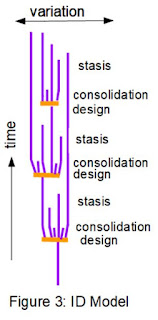 Then, at detectable moments in geological time, blasts of new species, genera, or even families arise almost suddenly, as "design" events, when new genetic information is injected into the biome. A brief period of "consolidation" would occur as the new information is integrated and accommodated by the new life forms. Some of those die out immediately as non-viable, or too few in number. Others adjust their phenotype or morphology as the new genes take effect, and settle out as new species.
Numerous plant and animal species have no known transitions from prior species; bladderworts and squids for example. Even some of the iconic transitional fossil sequences like horses and whales are not what they are presented to be in evolution textbooks. The steps (saltations) between the supposed intermediaries are huge from a genetic perspective, requiring many genetic additions and long fixation times.
In the case of whales, for example, only a few million years separates the supposed Pakicetus, land-based starting point from the earliest known, fully-formed aquatic whale. Such a transition would require an enormous amount of new genetic information in the form of many new genes. Meanwhile, population genetic models suggest that the time required for even a single mutation to be "fixed" in a population of say, 10,000 whale precursors with a ten year reproduction cycle, could exceed that time frame. It is beyond belief that many thousands of just right mutations, arising randomly, could occur in that time frame, resulting in a totally new family of whale species.
It is much more reasonable to suggest that, at such moments, an intelligent agent interceded somehow, to develop an array of new species and introduce them into Earth's biosphere. How that could be done, whether by purposely adding to or modifying DNA in various extant species, or by "creating" new species using similar genetic building blocks, with a few additions, cannot be known at present, although I have previously speculated on how this might be done. The injections of new information would likely occur in small populations, which are then released into the wild. With low numbers and short times during these consolidations, few if any fossils would be saved for us to dig up, and the fossil record would appear the way it does in Figure 2.
With a batch of new genetic information added into various genomes, the initial "explosion" of different lifeforms would be huge. Many of those would not be viable, perhaps, depending on the distribution of the new genes, and many new "lines" would doubtless go extinct even before they got started, either due to detrimental effects, or the exigencies of life - most individual lives are lost by random chance rather than from being slightly less fit. Nevertheless, enough new life forms would survive the first few generations, and would quickly settle down, via Darwinian selection, into separate, stable, viable species. By the time these became numerous enough to get one or more preserved in the fossil record, they would be a thriving species, now in equilibrium with its environment. Hence the punctuations in the fossil record, leading to steady state or "stasis".
This model suggests a range of potential research areas. The fossil record is an obvious starting place. Look for and catalogue all the sudden eruptions of new life forms without apparent precursors. How often do they occur? Are they all at once for all of life on Earth, as in the Permian extinction, or are they smaller in scale, limited to one area of the globe, or one set of lifeforms at the genus or family level? The fossil record is well established, even if it is still filling in slowly, so the data to do this must exist, even if no one has looked at it in this way.
On the biomolecular side, continue to research and collect the genetic changes that have caused known speciation events. In some cases, the "molecular clock" (such as it is) for random mutations, can be used to estimate when certain genes, similar among different species, were once the same gene, suggesting a branch point in life's tree, or at least in the subsequent existence of that gene. Similar approaches can be used to estimate when a given gene, perhaps one unique to a particular species, first came into being. For example, by looking at the variation in a single, uniquely human gene among extant human beings, the "age" of that gene - when it first arose - based on the accumulated variations, can be estimated.
It is conceivable that, as the fossil record is looked at more closely, and as the picture of genetic histories becomes clearer, the groups, dates and possibly locations may start to overlap, pointing to when and where the injections of new genetic info occurred. This is obviously a long term project. There will be lots of "noise" and gaps in the data, but if such a consilience or agreement between fossils and molecules can be found, it would be a major discovery.
The third piece of research would be to use comparative genetics to estimate how much genetic info was injected at these supposed design interventions by the intelligent agent. For example, what features and functions existed in possible partial precursor species, and what additional genetic information would be needed to account for the added or different features seen in the new species that arose? This could be done by carefully examining what genes are needed for similar features or functions seen in extant species. None of this would be precise or definitive, of course, but it could be useful and could hint at how the information was added.
For example, if some newly arisen species had (or its extant descendants have) a set of genes required for some new feature, and it can be shown that those genes could have come from two different families that cannot breed together, then clearly, one good explanation is that the agent took existing genes from two disparate species, and combined them to produce a novel feature in a new species. This would rule out the small genetic tweaks approach to developing a new line of lifeforms.
One last area of research for the proposed model would be to look closely at what blind Darwinian mechanisms can actually achieve over geological time scales. That is, at what level of variation and adaptation among species can random mutation plus natural selection alone - without intelligent direction, or added genomic information - produce actual genomic and morphological changes, possibly including new species? Several natural mutational and genomic change mechanisms are well known, and mathematical models exist to explore their realistic effects over time in a population of some size. The influence of environment and competition can be added to these models to see how much blind evolution might be possible. Actually, a lot of this work has already been done, including some empirical lab work, much of it by ID proponents seeking to determine where the line between natural evolution and ID must be in the hierarchy of life forms. See Michael Behe's The Edge of Evolution, for example. Indeed, initial considerations of this sort were key to the inception of ID theory, but additional research could provide a lot more understanding and insight.
Instead of trying to debunk Darwinism on the one hand, or completely dismissing Intelligent Design on the other, we should combine them into a better scientific paradigm for evolution. This reflects Hegel's philosophy of thesis (Darwinism), antithesis (ID) and synthesis (the combined model) as applied to evolution. As I understand the current situation, some form of ID theory is gaining credibility among scientists of various stripes, and in various places. Once ID is allowed to exist peaceably alongside the 150 year sole reign of Darwinism and its own neo-synthesis, then the above research can begin in earnest, exploring the model offered in Figure 3. It may be that the above suggestions will lead nowhere or to a mishmash of uncertainty, but even that would tell us something. Surely, however, even the possibility of finding out something about when and how the intelligent agent was at work, would be a huge addition to our scientific knowledge about the origin and history of life on Earth, and our relationship with the creator and the cosmos.
 First the science. There are two principal lines of evidence to consider, the fossil record and modern molecular biochemistry. Charles Darwin expected the "tree of life" in the fossil record to look something like Fig. 1, with "species" constantly but gradually changing and occasionally splitting in two as branches appear and diverge. However, even he noticed a paucity of "transitional forms" in the fossil record. Instead fossilized species appear suddenly without obvious precursors or intermediate steps from the supposed previous branch of the tree, change very little over the millions of years and then fade out and (mostly) go extinct, with no obvious new species arising from them, as shown roughly in Fig. 2. Science articles often add horizontal dashed lines to such "trees" to show the supposed connections and transitions, but those do not represent the actual fossils.
The fossil record aspect most perplexing to Darwin was the so called Cambrian explosion. Some 540 million years ago (MYA), at the start of the Cambria
 n period of geological history, numerous new complex lifeforms, with sophisticated features like eyes, body plans, legs, swimming, mouths and guts, nervous systems, etc. burst into existence over just a few million years, with no apparent precursors from the previous Ediacaran age, which recorded only simple worms, algae mats, sponges, and the like as fossils. Darwin hoped that subsequent fossil finds would fill in the blanks, but that has not happened for the most part, and the same is true all through the fossil record.
This conundrum for gradualist evolution remains as true today as it did 150 years ago, with no credible naturalistic explanation. Indeed, the problem was so clear in 1972 that Niles Eldredge and Stephen Jay Gould suggested the Punctuated Equilibrium (PE) model for evolution, claiming that the transitions happened so quickly that none of them were fossilized, and that the new species became populous as equilibrium forms, with little of no further phenotype (physical) changes until the next punctuation hit. Not only does this go against Darwin's clear requirement that there be no sudden major changes ("saltations" he called them), but it also goes against population genetics, which shows it is much harder to get major mutation changes - the kind needed to create a new species - over short period and in a small population, as required by the PE theory.
On the other hand, ID says, of course species remain largely fixed phenotypes as long as they exist, because the Darwinian mechanism, working in known ways on genomes, cannot create new features or the major genetic changes needed for totally new species. Many - perhaps most - species have one or more gene unique to them, with nothing similar in any other species. These so called orphan genes cannot be explained by a Darwinian mechanism (random mutation, plus natural selection) working on precursor genomes in any reasonable geological time. Any new feature in the fossil record would have required many new proteins (and hence genes) to construct the feature, and others to integrate it into the lifeform and make it functional, thereby rendering the transition even less likely for any purely natural process.
This finding of molecular biochemistry leads to the second piece of evidence for the process I will outline below. Studies of extant species demonstrate that for the most part, any traceable genetic effects leading to new species have arisen by devolution, that is, the damaging or removal of one or more genes in a pre-existing genome. Hence polar bears, for example, evolved from brown bear cousins by damaging the genes that limited their fat intake, allowing them to eat fatty seals without health problems, and by damaging the gene for melanin that produces dark pigments, leaving their fur white. Presumably such mutations first occurred in brown bears, but were not beneficial to them. However, when the polar bears forebears migrated into the arctic, those mutations were beneficial, helping the polar bear thrive in the new environment, and so were selected and then fixed into the growing population.
Yes, this is a clear case of Darwinian evolution producing a new species, just as Darwin claimed. Sometimes, Darwinism actually works! Note however, that although beneficial, those mutations damaged the genome, knocking out or damaging multiple genes. No new genetic information arose. Michael Behe, in his book Darwin Devolves describes this effect in depth. The same finding applies to almost every known case of beneficial mutation. Bacteria become resistant to antibiotics by damaging the genes that generate the cell-wall portals through which the antibiotics attack them. This is like an army burning its bridges behind them during a retreat: yes, it saves your army and slows down the enemy, but only by destroying part of your infrastructure that's needed in normal life.
Behe describes numerous examples, his first rule of adaptive evolution is to, "break or blunt any functional coded element whose loss would yield a net fitness gain". In hindsight, this effect should have been obvious. For any given gene, damaging mutations are far more likely than ones that might improve the gene somehow. Any new feature or function in an organism requires new proteins or enzymes, which therefore require new genetic information, and not just one or two minor changes. Most genes are hundreds of nucleotides long, and the probability of a new functional gene arising de-novo, by random mutations is all but negligible. On the other hand, a single point mutation in a gene is often enough to damage or render inoperative the resulting protein molecule. Thus, if a benefit to the species can be had by knocking out or damaging a particular gene, it is easy to do - just wait for almost any mutation to that gene - and very effective. It is easier and quicker to burn your bridges than to develop new weapons and rebuild your army to counterattack. Other research supports Behe's arguments and conclusions.
So Darwinism works, at least in this very limited sense. However, evolution by damaging the genome does not get us new biological features and functions. The polar bear is still a bear, and indeed could still mate with brown bears in principle. Devolution can only take you so far. Another example is dogs, which apparently evolved from wolves, via selective breeding - not quite natural selection, but the same rule applies. Most of the variations and new breeds of dogs have arisen by knocking out or damaging genes, or gene variants (alleles) found in wolves. Sure you get new breeds, but all dogs are still dogs - no new features - and one does not have to think too long about how most dog breeds would survive in the wild competing with wolves (natural selection). By damaging or removing parts of the genome, you can indeed get somewhat different life forms, but you cannot get anything completely new. For that, you need to add new genetic information, new genes that work together for new functions or phenotypic features. The Darwinian process of random mutations and natural selection simply cannot accomplish that.
In addition to the Cambrian explosion, there were other brief periods (almost moments) in geological time when whole batches of new life forms came into existence suddenly. Some examples include the Avalon explosion, and the bursts of new life forms following mass extinction events. Naturalist Darwinians claim these extinctions opened up numerous ecological niches which were then filled with newly evolved life forms. Yet they have no mechanism to credibly account for where the new genetic information came from for these new species that suddenly pop into existence.
The evolution model I would like to propose to account for the tree of life as it appears in the fossil record, builds on these findings of the last century or so. Figure 3 sketches what I have in mind, essentially an expansion of the PE model, with ID added in to account for the punctuations. Most of the time life goes on without much change. Species remain largely unchanged with some going extinct, and only occasional "new" species arising via devolution. These new species are very similar to their precursors. Think of all the dinosaurs, for example; numerous ones look very similar to each other, changed only in size or minor tweaks to their bones, yet each one gets a new name when unearthed. This is Darwinism at work, tweaking the world a little bit over millions of years, while the fossil record remains in equilibrium mode or "stasis".
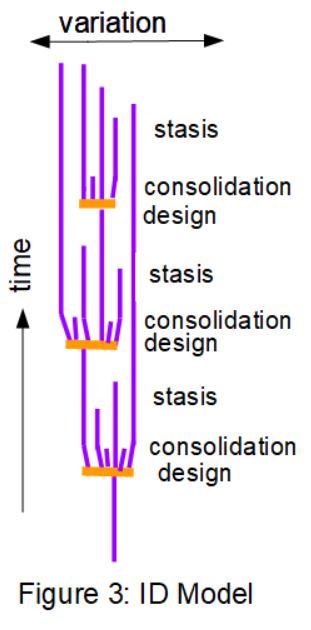 Then, at detectable moments in geological time, blasts of new species, genera, or even families arise almost suddenly, as "design" events, when new genetic information is injected into the biome. A brief period of "consolidation" would occur as the new information is integrated and accommodated by the new life forms. Some of those die out immediately as non-viable, or too few in number. Others adjust their phenotype or morphology as the new genes take effect, and settle out as new species.
Numerous plant and animal species have no known transitions from prior species; bladderworts and squids for example. Even some of the iconic transitional fossil sequences like horses and whales are not what they are presented to be in evolution textbooks. The steps (saltations) between the supposed intermediaries are huge from a genetic perspective, requiring many genetic additions and long fixation times.
In the case of whales, for example, only a few million years separates the supposed Pakicetus, land-based starting point from the earliest known, fully-formed aquatic whale. Such a transition would require an enormous amount of new genetic information in the form of many new genes. Meanwhile, population genetic models suggest that the time required for even a single mutation to be "fixed" in a population of say, 10,000 whale precursors with a ten year reproduction cycle, could exceed that time frame. It is beyond belief that many thousands of just right mutations, arising randomly, could occur in that time frame, resulting in a totally new family of whale species.
It is much more reasonable to suggest that, at such moments, an intelligent agent interceded somehow, to develop an array of new species and introduce them into Earth's biosphere. How that could be done, whether by purposely adding to or modifying DNA in various extant species, or by "creating" new species using similar genetic building blocks, with a few additions, cannot be known at present, although I have previously speculated on how this might be done. The injections of new information would likely occur in small populations, which are then released into the wild. With low numbers and short times during these consolidations, few if any fossils would be saved for us to dig up, and the fossil record would appear the way it does in Figure 2.
With a batch of new genetic information added into various genomes, the initial "explosion" of different lifeforms would be huge. Many of those would not be viable, perhaps, depending on the distribution of the new genes, and many new "lines" would doubtless go extinct even before they got started, either due to detrimental effects, or the exigencies of life - most individual lives are lost by random chance rather than from being slightly less fit. Nevertheless, enough new life forms would survive the first few generations, and would quickly settle down, via Darwinian selection, into separate, stable, viable species. By the time these became numerous enough to get one or more preserved in the fossil record, they would be a thriving species, now in equilibrium with its environment. Hence the punctuations in the fossil record, leading to steady state or "stasis".
This model suggests a range of potential research areas. The fossil record is an obvious starting place. Look for and catalogue all the sudden eruptions of new life forms without apparent precursors. How often do they occur? Are they all at once for all of life on Earth, as in the Permian extinction, or are they smaller in scale, limited to one area of the globe, or one set of lifeforms at the genus or family level? The fossil record is well established, even if it is still filling in slowly, so the data to do this must exist, even if no one has looked at it in this way.
On the biomolecular side, continue to research and collect the genetic changes that have caused known speciation events. In some cases, the "molecular clock" (such as it is) for random mutations, can be used to estimate when certain genes, similar among different species, were once the same gene, suggesting a branch point in life's tree, or at least in the subsequent existence of that gene. Similar approaches can be used to estimate when a given gene, perhaps one unique to a particular species, first came into being. For example, by looking at the variation in a single, uniquely human gene among extant human beings, the "age" of that gene - when it first arose - based on the accumulated variations, can be estimated.
It is conceivable that, as the fossil record is looked at more closely, and as the picture of genetic histories becomes clearer, the groups, dates and possibly locations may start to overlap, pointing to when and where the injections of new genetic info occurred. This is obviously a long term project. There will be lots of "noise" and gaps in the data, but if such a consilience or agreement between fossils and molecules can be found, it would be a major discovery.
The third piece of research would be to use comparative genetics to estimate how much genetic info was injected at these supposed design interventions by the intelligent agent. For example, what features and functions existed in possible partial precursor species, and what additional genetic information would be needed to account for the added or different features seen in the new species that arose? This could be done by carefully examining what genes are needed for similar features or functions seen in extant species. None of this would be precise or definitive, of course, but it could be useful and could hint at how the information was added.
For example, if some newly arisen species had (or its extant descendants have) a set of genes required for some new feature, and it can be shown that those genes could have come from two different families that cannot breed together, then clearly, one good explanation is that the agent took existing genes from two disparate species, and combined them to produce a novel feature in a new species. This would rule out the small genetic tweaks approach to developing a new line of lifeforms.
One last area of research for the proposed model would be to look closely at what blind Darwinian mechanisms can actually achieve over geological time scales. That is, at what level of variation and adaptation among species can random mutation plus natural selection alone - without intelligent direction, or added genomic information - produce actual genomic and morphological changes, possibly including new species? Several natural mutational and genomic change mechanisms are well known, and mathematical models exist to explore their realistic effects over time in a population of some size. The influence of environment and competition can be added to these models to see how much blind evolution might be possible. Actually, a lot of this work has already been done, including some empirical lab work, much of it by ID proponents seeking to determine where the line between natural evolution and ID must be in the hierarchy of life forms. See Michael Behe's The Edge of Evolution, for example. Indeed, initial considerations of this sort were key to the inception of ID theory, but additional research could provide a lot more understanding and insight.
Instead of trying to debunk Darwinism on the one hand, or completely dismissing Intelligent Design on the other, we should combine them into a better scientific paradigm for evolution. This reflects Hegel's philosophy of thesis (Darwinism), antithesis (ID) and synthesis (the combined model) as applied to evolution. As I understand the current situation, some form of ID theory is gaining credibility among scientists of various stripes, and in various places. Once ID is allowed to exist peaceably alongside the 150 year sole reign of Darwinism and its own neo-synthesis, then the above research can begin in earnest, exploring the model offered in Figure 3. It may be that the above suggestions will lead nowhere or to a mishmash of uncertainty, but even that would tell us something. Surely, however, even the possibility of finding out something about when and how the intelligent agent was at work, would be a huge addition to our scientific knowledge about the origin and history of life on Earth, and our relationship with the creator and the cosmos.
Wednesday, 19 February 2020
The Problem of Evil - Theodicy 101
A common argument against God's existence is, "How can a good God allow bad things to happen?" For Christianity, this is "the problem of evil" in the world. One formulation of the argument says, if God is all powerful, he could prevent evil, and if he is all good, then he would surely do so; therefore, either he cannot or does not want to, and either way, he is not the theist idea of an all powerful, all good God. Of course this argument does not support atheism, but it does appear, on the surface, to undermine the Judeo-Christian view of who God is.
Theodicy is the term used for the apologetics of the problem of evil; explaining why there is evil in the world, and how a good God can allow evil to exist. Many explanations have been offered by better authors than me, and in more depth than I can go here. For example, C. S. Lewis has a go at it in his book God in the Dock. For a good on-line look at the topic, see this on YouTube. The topic is huge and, in the end, the sum of the responses and explanations is probably inadequate or unsatisfying to many, and perhaps especially for atheists. Nevertheless, I will have a go at it from my own perspective.
Few people will doubt that evil exists in the world; bad things do happen to everyone at some point. It is widely accepted that there are two types of evil in the world. Moral evil can be attributed to humans: starvation, war, murder, theft, rape, abuse, cheating, corruption, etc. Natural evil, on the other hand, refers to other forms of suffering not attributable to people: diseases of various sorts, earthquakes, tornados, floods, and other natural disasters, often referred to as "acts of God", even though they are all in the natural realm. In some cases, there is overlap between these two types, as when humans purposely spread, or withhold treatment for an otherwise natural disease, for example. There is also a third type of evil; spiritual evil, as in the actions of demons, curses, spells, and other occult phenomena. But if you don't believe in God, you probably don't believe in such things anyway, so here I will focus only on the moral and natural evils afflicting our world.
At the highest level, the explanation for both types of evil is 'The Fall'. Man rebelled against God, so things broke down and went wrong. In the garden of Eden, the first humans decided they knew better than God what was good for them and so went their own way, separating themselves from him. As a result they were evicted from the garden and had to deal with the resulting problems. Adam and Eve could have stayed in Eden with the tree of life, enjoying easy living forever, but foolishly they chose to rebel against God's simple instruction, and got what they were warned about. According to this doctrine, even the world itself suffered, and became less comfortable for people, animals and the rest of creation. Creation was damaged by man's disobedience, resulting in ongoing sin, death, suffering and evil.
No one is perfect and we all make stupid mistakes that sometimes cause hurt or damage, and sometimes we do these things on purpose. In Christianity, this tendency is called original sin. Whether you take the Eden story literally or allegorically, all humans are clearly prone to sin and, without guidance and discipline, do not naturally seek God and their neighbour's good. Even with careful upbringing and education, all people sometimes do things they know they shouldn't, or fail to do what they know is right. With this understanding, we see that God did not create the evil in the world, but he allowed it to happen. This explanation does not satisfy most people, so I will need to expand on it.
We humans were created with free will, the ability to choose between different actions for our own reasons. God values and honours our free will, in particular, our ability to ignore or deny him, so he allows evil to exist in the world as the direct result of our choices. The Bible teaches that we all have some evil in our hearts, that none of us on our own will seek God or always do the right thing. This doctrine of original sin is easy to demonstrate: every honest person will surely admit to knowingly doing things that were wrong. Pride, greed, envy, vengeance, hatred, fear, jealousy, ill wish, competition, and so on, are feelings experienced by all humans, and we all at various times succumb to and act on them, causing bad things to happen. I doesn't take much imagination to see how this explanation accounts for most if not all moral evil at the individual, group, national and global scales.
Suppose that God were to step in to stop our actions or block our evil intentions in order to prevent the evil from happening. We would then not be truly free, as for example, in a 1984-like police state where our every thought and move are monitored, and we are coerced into only one path at every choice of consequence. Not much free will there! Moreover, if our mistakes were corrected at each pass, we would never learn from them. Of course we are all free to choose the good and right, and perhaps we mostly do so, but we are still prone to evil choices and deeds, and God usually allows us to proceed, regardless of the consequences. God does not like what we do wrong, but he constrains himself in order to honour our free choices.
In addition to our free will, God values faith and wants us to recognize his existence, as well as his goals and desires for us. If God acted all the time to stop evil, there wouldn't be much room for faith since his actions would be obvious and predictable. This does not mean, I hasten to add, that believers don't continue to sin. We are ALL broken and fallen and need God's grace to grow in goodness, and we ALL need his forgiveness for our misdeeds. With sin and evil all around, it is hard - even impossible - to think and act perfectly, unless your name is Jesus the Christ.
In this approach to the issue, God's highest priority is not our health, comfort, safety, or well being, although he does want those for us. Rather his highest goal is for us to seek and find him, to turn our lives, hopes, dreams, behaviour, and thinking over to him willingly, trusting that he knows what is best for each of us. Our relationship with him is more important than minimizing or removing evil from the world. To maintain our free will, God allows our evil acts, even when they cause serious harm to others or his creation. And of course, he sent his Son Jesus to take the burden of our sins so that we would not have to pay the penalty for them - a penalty we could not possibly ever pay.
Some apologists for Christianity point out that not all pain and suffering is necessarily evil. Pain serves a purpose as physiological warnings: remove hand from hot surface, avoid those cactus spines, stop exercising when it hurts, etc. And we know we should seek help for injury or prolonged pain; e.g. toothache, sickness, overwork, self-harm, etc. Rest that sprained ankle, it hurts for a good reason!
Moreover, some types of suffering may build strength of character; the Christian version of, "Whatever doesn't kill you makes you better". Some people who go through evil times come out wiser and better for it, and in hindsight, no longer condemn the suffering they faced. Many Christians even report that more serious evils in their lives helped them grow as persons or believers. Some readers may find this questionable, but it is an oft-reported reality.
Humans may also be personally complicit in some types of seemingly 'natural' evils. It is hard to blame God for your lung cancer if you've been smoking all your life. If you break his rules about sexuality and catch a serious disease, don't rail against God. If you live on the shallow waterfront of a river, or ocean beach front in Florida, don't complain to God when you are flooded during a hurricane or spring runoff. Many similar situations could be listed. God gave us minds to make wise decisions, not to ignore danger signs we know about and understand.
According to Bible, the Fall also caused some natural evils to arise: labour pains for women, tough soil and weeds in farming, and ultimately, death itself (see Genesis 3:16-19). The moral aspects of all of creation are entwined together, so that our hereditary rebellion affects everything. This concept of evil could therefore be extended, in principle, to other perceived evils: animal attacks, sicknesses, even natural disasters.
It will, of course, be argued that natural disasters are entirely natural and not man made. But as science and technology progress, we have an increasing ability to mitigate or prevent these "evils" through, for example, tornado and tsunami warnings, rescue teams, safety standards and building codes, hurricane evacuations, reliability improvements, vaccines, cancer treatments, modern health-care, etc. To the extent that we do NOT develop and widely apply these so that suffering continues and people are hurt, some of these natural evils begin to look more like moral evils - largely intentional failures or oversights on our part in caring for our fellow humans. If we collectively choose to fund weapons development above health care or disease prevention, do we not become complicit in the resulting evils?
Nevertheless, these broad "explanations" cannot cover all forms of perceived evil in the world. They are particularly unsatisfying for certain specific evils: children dying of cancer, healthy people dying of heart attacks or struck by lightning, tornado deaths, random accidents, etc. These seem like real evils that mankind cannot completely mitigate or prevent. So there is always some residue of evil that is difficult to "explain away". In such cases, Christians fall back on trusting God and knowing that his ways are largely inscrutable to us mere mortals (see Isaiah 55:8-9, or Romans 11:33). That explanation will, of course, be particularly unsatisfying to non-believers. Theodicy can perhaps account for and explain most forms of evil to some degree, but the problem of evil does not go away, and remains a mystery and one of the most difficult areas of Christian theology.
To turn the tables, however, atheism also has a serious problem with evil. In a materialist world - nature is all, there is no God, no heaven or hell, etc. - there can be no good or bad other than how we individually or collectively feel about things. There is no absolute right or wrong, no "ought", only "what is". So how can atheists complain about evil except as special pleading, "I don't like this or that"? After all, we do not consider a lion to be evil when it kills an antelope to eat. If we are all just evolved apes, then how can we cry foul when bad things happen to us, or to our family and friends? To complain about evil in the world is to recognize that good and evil truly exist and that we have a moral compass to recognize unfairness and to express our deepest indignation about the suffering and harm so apparent around us. Ultimately to recognize good and evil as realities implies a moral source and some standard above material existence to judge events and their effects. That begins to look like spirituality, pointing to a Source for truth, or even to God. In this way, "the problem of evil" becomes a pointer to God's very existence.
There are many other similar postings, essays and entire books on the general subject of theodicy. Here, for example, is an excerpt from one such article:
Theodicy is the term used for the apologetics of the problem of evil; explaining why there is evil in the world, and how a good God can allow evil to exist. Many explanations have been offered by better authors than me, and in more depth than I can go here. For example, C. S. Lewis has a go at it in his book God in the Dock. For a good on-line look at the topic, see this on YouTube. The topic is huge and, in the end, the sum of the responses and explanations is probably inadequate or unsatisfying to many, and perhaps especially for atheists. Nevertheless, I will have a go at it from my own perspective.
Few people will doubt that evil exists in the world; bad things do happen to everyone at some point. It is widely accepted that there are two types of evil in the world. Moral evil can be attributed to humans: starvation, war, murder, theft, rape, abuse, cheating, corruption, etc. Natural evil, on the other hand, refers to other forms of suffering not attributable to people: diseases of various sorts, earthquakes, tornados, floods, and other natural disasters, often referred to as "acts of God", even though they are all in the natural realm. In some cases, there is overlap between these two types, as when humans purposely spread, or withhold treatment for an otherwise natural disease, for example. There is also a third type of evil; spiritual evil, as in the actions of demons, curses, spells, and other occult phenomena. But if you don't believe in God, you probably don't believe in such things anyway, so here I will focus only on the moral and natural evils afflicting our world.
At the highest level, the explanation for both types of evil is 'The Fall'. Man rebelled against God, so things broke down and went wrong. In the garden of Eden, the first humans decided they knew better than God what was good for them and so went their own way, separating themselves from him. As a result they were evicted from the garden and had to deal with the resulting problems. Adam and Eve could have stayed in Eden with the tree of life, enjoying easy living forever, but foolishly they chose to rebel against God's simple instruction, and got what they were warned about. According to this doctrine, even the world itself suffered, and became less comfortable for people, animals and the rest of creation. Creation was damaged by man's disobedience, resulting in ongoing sin, death, suffering and evil.
No one is perfect and we all make stupid mistakes that sometimes cause hurt or damage, and sometimes we do these things on purpose. In Christianity, this tendency is called original sin. Whether you take the Eden story literally or allegorically, all humans are clearly prone to sin and, without guidance and discipline, do not naturally seek God and their neighbour's good. Even with careful upbringing and education, all people sometimes do things they know they shouldn't, or fail to do what they know is right. With this understanding, we see that God did not create the evil in the world, but he allowed it to happen. This explanation does not satisfy most people, so I will need to expand on it.
We humans were created with free will, the ability to choose between different actions for our own reasons. God values and honours our free will, in particular, our ability to ignore or deny him, so he allows evil to exist in the world as the direct result of our choices. The Bible teaches that we all have some evil in our hearts, that none of us on our own will seek God or always do the right thing. This doctrine of original sin is easy to demonstrate: every honest person will surely admit to knowingly doing things that were wrong. Pride, greed, envy, vengeance, hatred, fear, jealousy, ill wish, competition, and so on, are feelings experienced by all humans, and we all at various times succumb to and act on them, causing bad things to happen. I doesn't take much imagination to see how this explanation accounts for most if not all moral evil at the individual, group, national and global scales.
Suppose that God were to step in to stop our actions or block our evil intentions in order to prevent the evil from happening. We would then not be truly free, as for example, in a 1984-like police state where our every thought and move are monitored, and we are coerced into only one path at every choice of consequence. Not much free will there! Moreover, if our mistakes were corrected at each pass, we would never learn from them. Of course we are all free to choose the good and right, and perhaps we mostly do so, but we are still prone to evil choices and deeds, and God usually allows us to proceed, regardless of the consequences. God does not like what we do wrong, but he constrains himself in order to honour our free choices.
In addition to our free will, God values faith and wants us to recognize his existence, as well as his goals and desires for us. If God acted all the time to stop evil, there wouldn't be much room for faith since his actions would be obvious and predictable. This does not mean, I hasten to add, that believers don't continue to sin. We are ALL broken and fallen and need God's grace to grow in goodness, and we ALL need his forgiveness for our misdeeds. With sin and evil all around, it is hard - even impossible - to think and act perfectly, unless your name is Jesus the Christ.
In this approach to the issue, God's highest priority is not our health, comfort, safety, or well being, although he does want those for us. Rather his highest goal is for us to seek and find him, to turn our lives, hopes, dreams, behaviour, and thinking over to him willingly, trusting that he knows what is best for each of us. Our relationship with him is more important than minimizing or removing evil from the world. To maintain our free will, God allows our evil acts, even when they cause serious harm to others or his creation. And of course, he sent his Son Jesus to take the burden of our sins so that we would not have to pay the penalty for them - a penalty we could not possibly ever pay.
Some apologists for Christianity point out that not all pain and suffering is necessarily evil. Pain serves a purpose as physiological warnings: remove hand from hot surface, avoid those cactus spines, stop exercising when it hurts, etc. And we know we should seek help for injury or prolonged pain; e.g. toothache, sickness, overwork, self-harm, etc. Rest that sprained ankle, it hurts for a good reason!
Moreover, some types of suffering may build strength of character; the Christian version of, "Whatever doesn't kill you makes you better". Some people who go through evil times come out wiser and better for it, and in hindsight, no longer condemn the suffering they faced. Many Christians even report that more serious evils in their lives helped them grow as persons or believers. Some readers may find this questionable, but it is an oft-reported reality.
Humans may also be personally complicit in some types of seemingly 'natural' evils. It is hard to blame God for your lung cancer if you've been smoking all your life. If you break his rules about sexuality and catch a serious disease, don't rail against God. If you live on the shallow waterfront of a river, or ocean beach front in Florida, don't complain to God when you are flooded during a hurricane or spring runoff. Many similar situations could be listed. God gave us minds to make wise decisions, not to ignore danger signs we know about and understand.
According to Bible, the Fall also caused some natural evils to arise: labour pains for women, tough soil and weeds in farming, and ultimately, death itself (see Genesis 3:16-19). The moral aspects of all of creation are entwined together, so that our hereditary rebellion affects everything. This concept of evil could therefore be extended, in principle, to other perceived evils: animal attacks, sicknesses, even natural disasters.
It will, of course, be argued that natural disasters are entirely natural and not man made. But as science and technology progress, we have an increasing ability to mitigate or prevent these "evils" through, for example, tornado and tsunami warnings, rescue teams, safety standards and building codes, hurricane evacuations, reliability improvements, vaccines, cancer treatments, modern health-care, etc. To the extent that we do NOT develop and widely apply these so that suffering continues and people are hurt, some of these natural evils begin to look more like moral evils - largely intentional failures or oversights on our part in caring for our fellow humans. If we collectively choose to fund weapons development above health care or disease prevention, do we not become complicit in the resulting evils?
Nevertheless, these broad "explanations" cannot cover all forms of perceived evil in the world. They are particularly unsatisfying for certain specific evils: children dying of cancer, healthy people dying of heart attacks or struck by lightning, tornado deaths, random accidents, etc. These seem like real evils that mankind cannot completely mitigate or prevent. So there is always some residue of evil that is difficult to "explain away". In such cases, Christians fall back on trusting God and knowing that his ways are largely inscrutable to us mere mortals (see Isaiah 55:8-9, or Romans 11:33). That explanation will, of course, be particularly unsatisfying to non-believers. Theodicy can perhaps account for and explain most forms of evil to some degree, but the problem of evil does not go away, and remains a mystery and one of the most difficult areas of Christian theology.
To turn the tables, however, atheism also has a serious problem with evil. In a materialist world - nature is all, there is no God, no heaven or hell, etc. - there can be no good or bad other than how we individually or collectively feel about things. There is no absolute right or wrong, no "ought", only "what is". So how can atheists complain about evil except as special pleading, "I don't like this or that"? After all, we do not consider a lion to be evil when it kills an antelope to eat. If we are all just evolved apes, then how can we cry foul when bad things happen to us, or to our family and friends? To complain about evil in the world is to recognize that good and evil truly exist and that we have a moral compass to recognize unfairness and to express our deepest indignation about the suffering and harm so apparent around us. Ultimately to recognize good and evil as realities implies a moral source and some standard above material existence to judge events and their effects. That begins to look like spirituality, pointing to a Source for truth, or even to God. In this way, "the problem of evil" becomes a pointer to God's very existence.
There are many other similar postings, essays and entire books on the general subject of theodicy. Here, for example, is an excerpt from one such article:
"For Augustine the Fall is central. According to him, God created an idyllic paradise with no suffering, death, or natural disasters. It was human disobedience that introduced these things into creation. Most educated people in the West no longer find that account plausible. The whole process of evolution involved the suffering and death of millions upon millions of creatures, within a context that included occasional earthquakes and floods. These facts are now part of the scientific data we must accept. And they strongly suggest that God, in the process of creation, built in the inevitability of suffering as a part of His method."I hope my writing here at least partly addresses the widespread complaint against Christianity regarding evil in the world. I am aware that it does not completely satisfy, but perhaps it cuts evil down to something less enormous and impossible to deal with. And discussion about evil should not be all negative or unhappy. There are things each of us can do to limit or mitigate evil in and around us. The next time you are upset about some particular evil in your life or in the world, consider:
- Have I helped bring this on by my own choices and actions? e.g. obesity, smoking, lack of exercise, unwilling to share my resources, being unkind, ignoring warnings, taking risks, letting anger, revenge, or hatred loose. There are many ways we can contribute to or aggravate evil around us.
- Is there something I or we could do to mitigate the effects of this wrong? e.g. can I help with pollution, hunger, loneliness, pandemics, poverty, crime, distrust, etc. How could I live better? e.g. honesty, generosity, love, compassion, gentleness, etc. There are many things even individuals can do to make the world a better place.
- If the "evil" is truly not my fault and cannot be significantly prevented or mitigated, then where do I go for comfort, solace, support, etc? Family, neighbours, agencies, government, or maybe, perhaps even God? God invites us to bring our cares to him in prayer, and many people do receive these, along with a degree of peace.
Addendum: Some Later (much later!) Thoughts.
There is far more to say on this topic. People have studied, speculated, analysed, struggled and theologized about it for millennia, in far more depth than I can pretend to. I am obviously not going to resolve it in a blog post - even an extended one. However, I have lately been reading Evil and the God of Love, by John Hick, an excellent introduction to theodicy from a historical and philosophical perspective. While he plays loose and fast with scripture, he does cover the topic and makes the reader think deeply. As I read through it therefore, some additional thoughts came to mind, as follows.
A major area of confusion I've seen is regarding the meanings of "good" and "evil" - whose good and what counts as evil? Some authors consider any pain or suffering from any cause to be 'evil'. Some even worry about 'metaphysical evil': why the world is not more perfect in every way? And why isn't everything angelic everywhere? That seems unnecessarily demanding, to my mind. We know that God made the world "very good", and was originally pleased with it. That should be good enough for us too, I trust, rather than being concerned about how God could somehow have made it 'better'.
Limiting ourselves to more prosaic, but very real sorts of evil, what should we include as "evil"? A wild-fire burns trees, a bird eats worms, a lion kills and eats a gazelle; surely those are not evil events? It is a lion's created nature to hunt, kill and eat other animals. The world's long history is filled with death and destruction: viruses kill bacteria, plants die and rot, animals are killed and eaten, violent natural disasters strike, and so on - all part of the natural, created order that long preceded humans and the Fall. Indeed scientists say that 99% of species that ever existed on Earth are now extinct. Is all that history truly evil? Perhaps the extinctions made way for better lifeforms or more variation over time, leading eventually to ourselves. Thus, while it may be disappointing for many to have no more trilobites or dinosaurs, their disappearance from creation need not be considered 'evil' in any moral sense. Mind you, I'm sure the gazelle is not happy to be killed in such a violent and painful way, and the dinosaurs probably felt pain as they were wiped out, but was any of that truly evil?
While I cannot speak for plants and animals, and they rarely speak for themselves, if we limit evil to include only natural evil affecting humans, combined with moral evil produced by human sin, then we vastly reduce the 'problem' of evil in the world to recent geological time when humans existed, or even later, after the Fall of Adam and Eve through their disobedience. Their sin was tasting of the fruit of the tree of "the knowledge of good an evil" against God's explicit command (Genesis 3:1-6). If good and evil were not known by humans prior to the Fall, then that should be a good place to start studying the problem of evil. I'll say more on this below.
On the other side of the question, what should be meant by "good"? There is the good of our individual private desires, the good for humanity's well being, and God's good for his eternal purposes; perhaps his creation's stability and endurance. Clearly these "goods" are not all the same. Your wishes can be the opposite of another person's, making it impossible to please you both. Surely that is not an evil, and even God could not fulfil each person's every wish. Moreover, as fallen humans, many of our wishes are wrong - indeed, evil - so we should look at a higher level to define "good". I suggest that since God is good, his definition of good should be the benchmark here. Of course we don't know for sure what that entails over the history of the universe, but we can hope and trust that it includes what is best for humanity in the long run. After all, God did send his son to pay for our sins and lift us out of our fallen condition, so he clearly wants the best for us - within his own context - as he originally intended.
Based on these understandings of "good and evil", there should be fewer distractions and difficulties to consider as we further discuss theodicy. My previous notes about evil and, especially, the human responsibility for essentially all moral evil, and perhaps aspects of natural evils, can still be applied. The following are some additional thoughts which may help explain why some level of 'evil' in the world is inevitable and thereby limit the arguments against a good God that started the need for a theodicy.
One such consideration is the overall story of the universe. Any good story - one worth reading or being part of - requires a plot and a variety of characters. If all the characters were identical, and perfectly good to each other, or if there were no difficulties, tensions or conflicts to be overcome in the story, it would be rather tedious and boring for all involved. Perhaps God, in his wisdom, made the universe including both good and the potential for evil - or at least difficulties to be dealt with - in order to make things interesting and worth doing, not just for him, but also for his creatures, especially those with spirits and the capability to commune with him; that is, us. We need challenges to help us strive, learn and grow. Some of those challenges may hurt or set us back, and so often seem like evil to us. Yet often in retrospect we see that we are better for the difficulties we have gone through. This does not absolve us or all evils, but may explain some of the gentler ones better, and narrow down the field a bit.
That explanation is a version of the "aesthetic approach" to theodicy, in which God allows certain problems and difficulties in order to make the world a better place - more beautiful, varied, exciting and changing - for its inhabitants. I note that some theologians' focus on "perfection" of the created world, including sinless humans is somewhat misplaced. God never viewed his creation as 'perfect', rather he called it "good" and then "very good". This suggests that there was room for conflict, disagreement, disappointment, sorrow, struggle, etc. and hence 'evil' at some level. Here too perhaps, the perfect is enemy of the good?
Another thought: perhaps in Eden human beings were endowed in a way that kept natural evils at bay. Carnivores would not harm them, they were immune from diseases, natural disasters occurred elsewhere, they were perhaps warned of impending dangers, and so on. Or perhaps those blessings would have been included with the fruit of "the tree of life", which they did not get around to eating? Once evicted from the garden, however, through their own fault, any such attributes were stripped off or faded away, making then susceptible to the same sufferings and hurts experienced by other animals, as suggested in Genesis 3:17-19.
Some more thoughts on the Fall: the "felix culpa" (happy fault) view holds that while God intended Adam and Eve to be innocent and naïve for a time, their Fall gave them "knowledge of good and evil", thereby allowing them to become fully moral creatures, for better or worse, and ultimately calling on Jesus as the blessed Redeemer to enter creation on our behalf as part of the unfolding of God's kingdom. Or perhaps God was saving the "knowledge of good and evil" for later, once they had matured in the protected place. Why else have that tree in the garden? Note too that Eden was indeed a garden and not the entire created world, suggesting that God started his people off there as a sort of newbie 'sandbox' environment, to let them grow and mature before releasing them into the wild world. They however, jumped the gun, gaining God's displeasure, and making life harder for themselves - a sort of hasty "childhood's end" that brought misery along with the opportunity for growth - but He still loved them and continued to care for them, albeit at some distance.
Having herein dabbled into theodicy and 'the problem of pain', evil and pain do not disappear, of course. Neither is all apparent evil our own fault or the due penalty for our own misdeeds. Evils, both natural and moral, are very real and the mystery of evil in a good world, with a loving God remains. However, by dividing up the scope and types of evil and explaining some of the above aspects of it, I hope I have provided a more nuanced perspective, reducing the scale and range of the problem, and opening up some avenues for further personal reflection. The problem of evil is very real and isn't going to go away, but it can be reconciled with a good and loving God who still wants the best for us and has done his best to make it possible for his spiritual creatures to have a good life, in fellowship with him, both now and eternally.
Thursday, 30 January 2020
Some Favourite Sayings
Here are some bits and pieces that I have collected over the years - a very mixed lot. I reserve the right to add more as I find them. Enjoy!
"Science advances one funeral at a time." Max Planck
"The foolish are often in error, but never in doubt." Modern proverb
"When all is said and done, more is said than done." Aesop
“He who marries the spirit of the age is soon a widower.” Dean Inge
"Science advances one funeral at a time." Max Planck
"The foolish are often in error, but never in doubt." Modern proverb
"When all is said and done, more is said than done." Aesop
“He who marries the spirit of the age is soon a widower.” Dean Inge
“If you don’t read the newspapers you are uninformed — if you do read the newspapers you are misinformed.” Mark Twain
"The problem with a quarrel is that it spoils a good argument." G. K. Chesterton
"When the observed facts come into conflict with a cherished theory, then it is so much the worse for the facts." Ernst Mach
"Everything we call real is made up of things that cannot be regarded as real. If quantum mechanics hasn’t profoundly shocked you, you haven’t understood it yet." Niels Bohr
“Heaven has a wall, a gate and a strict immigration policy. Hell has open borders. Let that sink in.” Published by Reggie McDaniel
"Human kind cannot bear very much reality." T.S. Eliot:
"The first moral obligation is to think clearly." Blaise Pascal
"Never attribute to malice that which is adequately explained by stupidity." Hanlon's Razor
"Science is a good servant but a bad master." Michael D. Aeschliman
"Religion without science is lame, but science without religion is blind." Albert Einstein.
Here are some of my own - not necessarily original:
"The problem with a quarrel is that it spoils a good argument." G. K. Chesterton
"When the observed facts come into conflict with a cherished theory, then it is so much the worse for the facts." Ernst Mach
"Everything we call real is made up of things that cannot be regarded as real. If quantum mechanics hasn’t profoundly shocked you, you haven’t understood it yet." Niels Bohr
“Heaven has a wall, a gate and a strict immigration policy. Hell has open borders. Let that sink in.” Published by Reggie McDaniel
"Human kind cannot bear very much reality." T.S. Eliot:
"The first moral obligation is to think clearly." Blaise Pascal
"Never attribute to malice that which is adequately explained by stupidity." Hanlon's Razor
"Science is a good servant but a bad master." Michael D. Aeschliman
"Religion without science is lame, but science without religion is blind." Albert Einstein.
Here are some of my own - not necessarily original:
You can't read while eating a grapefruit!Immoral + cross = ImmortalFunny how all free thinkers seem to think alike.Offense is more often taken than given.Most of the cells in your body are not human!For me He died, for Him I live!
Monday, 30 December 2019
Small Could be Beautiful?
Over the past two centuries, the average height of humans in developed countries has increased; microevolution in action, although it can be argued that this effect is more due to improved health care and nutrition than to any significant genetic changes. One doubts that tall people have more children than shorter ones. In any case, this shows that it is possible to breed humans for simple changes in stature, just as we have bred dogs and other animals of different types and sizes. Leaving aside the shadow of eugenics for the moment, I want to suggest that, instead of breeding taller humans, we should breed ourselves shorter -- significantly smaller.
Taller people are not necessarily healthier, smarter or more successful, just as shorter people are not less well off, unhealthy or of lower mental acuity in general. However, it is clear that taller or bigger people need and use more resources than smaller folk. Very tall people, aside from being better at basketball, have serious problems with doors, cars, chairs, clothing, and other standard acoutrements of civilization than normally sized people. Moreover, very tall people and certainly oversized (that is, wider) people have health issues that occur less frequently in smaller (or thinner) people.
We already have some small people with us, those with dwarfism of various types and degrees, often proportionate (sometimes called midgets), for example. Although they may have some associated health issues, they can live happily, even in our normal-sized cultures. Now imagine what would happen if everyone was smaller, say about one meter tall, give or take -- child, or hobbit size you might say.
There would be significant benefits to humanity and the world if we were all smaller. If houses, cars, roads, etc. were designed for people one meter tall, instead of 1.7 m tall (5 ft 6 in, the approximate current average), and were proportioned about the same as hobbits, or normal five year old children, our average weight would be only around 20 kg or 45 lbs. This would solve or mitigate all sorts of obesity issues at the very least! It would also mean that we would need less food and numerous other resources to live a healthy and fulfilled life.
A world of hobbits could include at least twice the number of people as our world for the same resource usage. This would solve the "overpopulation" problem many seem to worry about. In any case, being 1m tall would greatly reduce your "carbon footprint", not to mention your actual footprint! Small shoes should be cheaper to make, transport and stock. This saving applies in spades for houses and cars, and all that they entail. Instead of 8 ft ceilings, queen sized beds, doors 32" wide, and so on, we could have 5 ft ceilings, and everything else proportionately smaller too. A 500 sq ft house would serve as well as a 1500 sq ft one does today. Think of the heating and air conditioning savings that could accrue, not to mention the capital cost of building and buying the house. Smaller schools, malls and other buildings would multiply this benefit.
In particular, cars could be four feet wide (1.2 m) instead of six or more, and much shorter in length and height as well. This would reduce their weight by 70% or more, while increasing their gas mileage accordingly. Trucks could also be smaller since most of the cargo they carry would be reduced in size and weight accordingly. I suspect that less human and metal momentum would make traffic accidents less serious as well, even without reducing speed limits. Of course, smaller vehicles would mean narrower roads, smaller bridges, and other infrastructure, all saving additional cost and resources. Lower taxes maybe? (dream on).
Narrower roads and smaller buildings allow more people to live in the same area, or the same numbers to live in less than 35% of the area for cities and towns. Smaller cities means quicker commutes, less pollution, and freed-up land for agriculture, recreation or nature. One can envisage all sorts of benefits that would accrue if humans were about one meter tall on average. Even space exploration would be easier and less costly, given the cost per kg of placing humans into orbit and maintaining them there. Little green men, meet little pink men!
With everything human much smaller, unchanged natural environments - trees, plants, animals, rivers, etc. - would seem larger to us, but human activity and interactions would be largely unaffected. There is little, aside from most sports, that would suffer from making people significantly shorter, and sporting achievements should be easy to reset for smaller folk -- scale down Olymoic records, football fields, etc. In developed countries, there are few jobs that still require large people, aside from the arbitrary standards for firefighters, military, etc. Indeed, smaller soldiers would be harder to target, and could fly smaller airplanes, or drive smaller (and cheaper) tanks. Big construction equipment could be just as easily driven by smaller workers, as could farm equipment.
With some joint effort by all nations, coupled with advanced genetic knowhow, we could easily breed ourselves to have smaller stature, and could probably achieve the one meter average within, say six generations, so that by 2200, the goal would be achieved and we could start reaping the benefits noted above. This would go a long way to addressing the climate change worries that some people have. In principle, meter high humans, with associated right-sized infrastructure, should used less than a third as much carbon as we full-sized ones, even without other changes. If we can breed dogs one quarter the size of wolves, reducing the average human height by only 40% should be easy.
This is all tongue-in-cheek, of course, I am not seriously proposing that we try to shrink humans over the next 150 years. Not only would that proposal be laughed away as a joke, impossible to enact meaningfully, and attract lots of negative responses, but it would raise the ugly prospect of eugenics, the use of genetic manipulation and coercive laws to make humanity "better" according to some elite goal or standard. Eugenics has had a nasty track record in 20th century Germany, the USA and elsewhere. If we start breeding smaller humans, why not smarter, or more beautiful ones? That way leads to a Brave New World that inevitably results in totalitarian measures, and groups of people judged unfit, or of lower importance, by those deemed superior somehow. I certainly do not want to go there.
So, people as hobbits is an interesting exercise, but it must remain a thought experiment. We will have to find other ways to limit our footprints on the world we have, and make more efficient use of its limited resources. Alas, our track record for doing that in the developed world has been less than stellar. So unless everyone is willing to shrink their stature, we should all try harder to shrink our negative impacts on the planet. If we all did that, we would not have to wait 200 years to see the benefits.
Taller people are not necessarily healthier, smarter or more successful, just as shorter people are not less well off, unhealthy or of lower mental acuity in general. However, it is clear that taller or bigger people need and use more resources than smaller folk. Very tall people, aside from being better at basketball, have serious problems with doors, cars, chairs, clothing, and other standard acoutrements of civilization than normally sized people. Moreover, very tall people and certainly oversized (that is, wider) people have health issues that occur less frequently in smaller (or thinner) people.
We already have some small people with us, those with dwarfism of various types and degrees, often proportionate (sometimes called midgets), for example. Although they may have some associated health issues, they can live happily, even in our normal-sized cultures. Now imagine what would happen if everyone was smaller, say about one meter tall, give or take -- child, or hobbit size you might say.
There would be significant benefits to humanity and the world if we were all smaller. If houses, cars, roads, etc. were designed for people one meter tall, instead of 1.7 m tall (5 ft 6 in, the approximate current average), and were proportioned about the same as hobbits, or normal five year old children, our average weight would be only around 20 kg or 45 lbs. This would solve or mitigate all sorts of obesity issues at the very least! It would also mean that we would need less food and numerous other resources to live a healthy and fulfilled life.
A world of hobbits could include at least twice the number of people as our world for the same resource usage. This would solve the "overpopulation" problem many seem to worry about. In any case, being 1m tall would greatly reduce your "carbon footprint", not to mention your actual footprint! Small shoes should be cheaper to make, transport and stock. This saving applies in spades for houses and cars, and all that they entail. Instead of 8 ft ceilings, queen sized beds, doors 32" wide, and so on, we could have 5 ft ceilings, and everything else proportionately smaller too. A 500 sq ft house would serve as well as a 1500 sq ft one does today. Think of the heating and air conditioning savings that could accrue, not to mention the capital cost of building and buying the house. Smaller schools, malls and other buildings would multiply this benefit.
In particular, cars could be four feet wide (1.2 m) instead of six or more, and much shorter in length and height as well. This would reduce their weight by 70% or more, while increasing their gas mileage accordingly. Trucks could also be smaller since most of the cargo they carry would be reduced in size and weight accordingly. I suspect that less human and metal momentum would make traffic accidents less serious as well, even without reducing speed limits. Of course, smaller vehicles would mean narrower roads, smaller bridges, and other infrastructure, all saving additional cost and resources. Lower taxes maybe? (dream on).
Narrower roads and smaller buildings allow more people to live in the same area, or the same numbers to live in less than 35% of the area for cities and towns. Smaller cities means quicker commutes, less pollution, and freed-up land for agriculture, recreation or nature. One can envisage all sorts of benefits that would accrue if humans were about one meter tall on average. Even space exploration would be easier and less costly, given the cost per kg of placing humans into orbit and maintaining them there. Little green men, meet little pink men!
With everything human much smaller, unchanged natural environments - trees, plants, animals, rivers, etc. - would seem larger to us, but human activity and interactions would be largely unaffected. There is little, aside from most sports, that would suffer from making people significantly shorter, and sporting achievements should be easy to reset for smaller folk -- scale down Olymoic records, football fields, etc. In developed countries, there are few jobs that still require large people, aside from the arbitrary standards for firefighters, military, etc. Indeed, smaller soldiers would be harder to target, and could fly smaller airplanes, or drive smaller (and cheaper) tanks. Big construction equipment could be just as easily driven by smaller workers, as could farm equipment.
With some joint effort by all nations, coupled with advanced genetic knowhow, we could easily breed ourselves to have smaller stature, and could probably achieve the one meter average within, say six generations, so that by 2200, the goal would be achieved and we could start reaping the benefits noted above. This would go a long way to addressing the climate change worries that some people have. In principle, meter high humans, with associated right-sized infrastructure, should used less than a third as much carbon as we full-sized ones, even without other changes. If we can breed dogs one quarter the size of wolves, reducing the average human height by only 40% should be easy.
This is all tongue-in-cheek, of course, I am not seriously proposing that we try to shrink humans over the next 150 years. Not only would that proposal be laughed away as a joke, impossible to enact meaningfully, and attract lots of negative responses, but it would raise the ugly prospect of eugenics, the use of genetic manipulation and coercive laws to make humanity "better" according to some elite goal or standard. Eugenics has had a nasty track record in 20th century Germany, the USA and elsewhere. If we start breeding smaller humans, why not smarter, or more beautiful ones? That way leads to a Brave New World that inevitably results in totalitarian measures, and groups of people judged unfit, or of lower importance, by those deemed superior somehow. I certainly do not want to go there.
So, people as hobbits is an interesting exercise, but it must remain a thought experiment. We will have to find other ways to limit our footprints on the world we have, and make more efficient use of its limited resources. Alas, our track record for doing that in the developed world has been less than stellar. So unless everyone is willing to shrink their stature, we should all try harder to shrink our negative impacts on the planet. If we all did that, we would not have to wait 200 years to see the benefits.
Tuesday, 19 November 2019
Is Science Going Off The Rails?
Science is a human pursuit based on asking intelligent questions, making educated guesses, trying different things, and then seeking to understand what it all means. The scientific method applied over past centuries has greatly improved life for humans all around the globe and has increased our understanding and control of nature enormously. I love science and have studied it all my life, but in recent times, the practice of science seems to be going off the rails in some ways. Science should not be influenced, much less directed by personal power, fame or greed. It should not be swayed by political or ideological biases. Yet scientists too are human, and the institutions, research centres and funding agencies are also all too human, so those unwanted influences have been creeping into many aspects of scientific work.
The most well known examples of this are in the so-called soft sciences - sociology, psychology, anthropology - as well as in health sciences such as psychiatry, nutrition, medicine and related specialities. There have been recent attempts to verify or reproduce published findings in some of these areas, and in many cases - even most in some reports - the published results were found to be wrong or not supported by the evidence. Then there are the human studies that tend to confirm politically correct assumptions and biases, regardless of the evidence, or where the experiments are skewed to yield preferred results irrespective of the truth. There has been much soul searching in some quarters, and the number of retracted papers continues to mount.
We all make fun of the nutritional flip-flops from experts on things like the health dangers (or benefits) of wine, salt, animal fats, eggs, coffee, and so on - to the point that few people take such pronouncements seriously now. Even the gold standard of randomized, double-blind drug studies can come to unwarranted conclusions based on selection bias, corporate pressures, statistical legerdemain and other human foibles, conscious or otherwise. Doubtful therapies, unnecessary procedures, questionable medication regimes abound, all at great cost. Such concerns are now a regular component of science publishing.
In the area of psychology and mental health, discounted Freudian theories and social Darwinist influences can still be found. Then there is the over-medication for any "condition" considered outside some assumption of "normalcy". Hence we get huge numbers of people on anti-depressants, anti-anxiety drugs, ADHD medications, and so on. Over-medication has led to the problems of antibiotic resistant diseases, and much of the opiate crisis that is currently devastating many in our society. Yet the pharmacology industry continues to promote new and often unproven drugs.
Under the spell of political correctness, many scientists and related professions pretend not to know when human life begins - a simple scientific fact understood for more than a century. More recently, under the fad of transgenderism, we allow doctors to experiment on children with hormones, to mutilate their otherwise healthy bodies, and to leave them infertile and on drugs for life, all supported by pseudo-scientific pronouncements from "gender theory experts". Meanwhile, we make certain types of counselling illegal because powerful interest groups don't like them and dredge up "studies" to support their agenda, despite evidence that other people want and benefit from them. The ever-progressive media lap this up, and the confused public is left wondering or silenced by self-censorship on social media. Yes, some of what passes for science these days can be autocratic, obsessive and quite ugly.
The hard sciences are no longer immune to such improper influences and the need to follow certain ideas and approaches in order to chase further research dollars. Climatology is unduly enamoured to the "settled science" of climate change, notwithstanding the lack of hard evidence and the mounting strikes against the theories, models and over-hyped alarmist pronouncements. Regardless of what you think about climate change, it is not good science to overstate selective or uncertain findings while shutting down or denouncing research results from the other side of the issue. False projections, fear mongering and demonizing your doubters do not promote public respect for the authority of science. Scientists are supposed to try to disprove their theories, not shore up their preferred hypotheses with filtered data, while ignoring results they don't like. "Science is faith in doubt", as some have said, but this does not seem to apply to certain favoured theories these days.
Biology in general has been wedded to Darwin's theory of evolution far too long, ignoring or denying counter evidence that continues to pile up. This faith in an unproven theory-by-extrapolation has led to factual errors such as the myth of "junk DNA" for instance, and epicycle-like attempts to account for all the myriad complexities of life forms. The Darwinian paradigm is crumbling, but most biologists still fail to recognize the fact, and many go out of their way to censor, dismiss and shut down alternative viewpoints and their findings.
Some branches of chemistry are likewise swayed or even blinded by their deeply held, but unscientific preconceptions. The obvious example is origin of life (OOL) research. Not a year goes by without some scientist publishing yet a new "breakthrough" in OOL research, which is then published as if it is just a matter of connecting a few dots to explain how life arose on Earth. Meanwhile, the truth is quite the opposite: the more we learn about biochemistry and related areas, the harder it becomes to find credible natural pathways from non-life to life.
Even the king of hard sciences, physics, is not without its defects. At the limit of the very small, theoreticians are looking for ever more esoteric "particles" which they hypothesise existing (such as WIMPS, MACHOs and AXIONs), but for which there is little or no experimental evidence. There are now pleas for many billions more dollars to build ever larger accelerators to look for such imagined particles. Meanwhile, whimsical and esoteric "grand unified theories" (or theories of everything) attempt to account for all the known forces, while postulating various new unknowables. Yet our two most successful theories in physics - quantum mechanics and relativity - are mutually incompatible.
At the other end of the scale range, cosmology is tripping over various murky hypotheses about what makes up 95% of the universe, while pretentiously explaining in great detail what must have happened in the first attoseconds of the big bang, using ungainly theories of "inflation". Meanwhile "dark matter" and "dark energy" continue to elude capture and even consistent definition. And recently, to avoid the need to acknowledge that the universe had a definite beginning and the obvious precision fine tuning that goes along with that, some posit an increasing menagerie of unobservable and complicated multiverses, setting aside Occham's razor in favour of elegant mathematics.
Again, don't get me wrong, I love science, and especially physics, but in general, much of the scientific enterprise seems to be wandering beyond reality. Retractions are on the rise, more and more time is spent publishing the latest marginal findings, and chasing continued funding or the all-important citations in the literature. Reputation and the reigning paradigm seem to trump actual content, valid conclusions, and credible advances. Overstatement, emotive appeals and even unfounded hype leak into publications and get blown out of proportion by the eager science media. Interpretations go beyond the evidence, especially in controversial areas, while unpopular implications of research are denied, ignored or suppressed.
Meanwhile, there is now a whole breed of publicity-seeking scientists making pronouncements way outside their areas of expertise, and the public toss about unfounded statements of what "science says" or "studies show", without even being able to cite their sources. Much of science has become politicized with favoured viewpoints skewing or sometimes even dictating how experimental results shall be interpreted and reported, even if the conclusions are not supported by the data.
All of this serves science poorly. Instead of neutrally investigating hypotheses and welcoming alternative perspectives and theories, much of science is now stuck in favoured paradigms and looking mostly to shore up reputation, funding, esteem and legacies. Thus, science has shifted from the idealized view of Karl Popper, that only falsifiable hypotheses are science, to the more cynical views of Thomas Kuhn, where paradigms of belief are held firm until the old guard dies off. As Max Planck famously said, "Science advances one funeral at a time".
A lengthy look at the trends in modern scientific studies led one non-scientist observer to write:
"Both natural and social science investigators have exhibited many of the pathologies of modern science, i.e. failing to report negative findings, ignoring counter evidence, relying on correlation rather than on more rigorous test for causation, failing to pursue replication studies that would confirm - or refute - earlier results, misusing data, attributing higher levels of accuracy to their data than warranted, and torturing statistics in order to produce more useful outcomes. Much of this abuse is driven by competition for funding and prestige that characterizes modern academic research, but some of it is driven by ideological preferences."
Michael Hart, Hubris: the Troubling Science, Economics and Politics of Climate Change, pg 565.
Even at Scientific American, blogger John Horgan has unkind things to say about the declining state of science today: the replication crisis, questionable motives in the healthcare industry, the overhyping of incremental research findings, untestable hypotheses touted as science, and so on. Here is another blog saying much the same thing, but in better words than mine above.
I am not a scientist myself, and do not have firm suggestions to improve how science is done. Fortunately, however, many people are beginning to take note of the problems outlined above and wiser heads have made suggestions on how science can be made fairer, more open and transparent, and less connected to financial and societal success. Science is important to future human and environmental well-being, and the better scientific establishments are at doing true science, the better the public will accept their results and appreciate the work they do.
By all means everyone should study science, but it is best to do so with a sceptical mind, looking for weasle words, hidden biases, unstated assumptions, and unsubstantiated conclusions. Consider alternative interpretations and look for critical analyses of published findings. The deeper you delve into science, the more interesting it gets, even as it remains a messy, all too human pursuit.
The most well known examples of this are in the so-called soft sciences - sociology, psychology, anthropology - as well as in health sciences such as psychiatry, nutrition, medicine and related specialities. There have been recent attempts to verify or reproduce published findings in some of these areas, and in many cases - even most in some reports - the published results were found to be wrong or not supported by the evidence. Then there are the human studies that tend to confirm politically correct assumptions and biases, regardless of the evidence, or where the experiments are skewed to yield preferred results irrespective of the truth. There has been much soul searching in some quarters, and the number of retracted papers continues to mount.
We all make fun of the nutritional flip-flops from experts on things like the health dangers (or benefits) of wine, salt, animal fats, eggs, coffee, and so on - to the point that few people take such pronouncements seriously now. Even the gold standard of randomized, double-blind drug studies can come to unwarranted conclusions based on selection bias, corporate pressures, statistical legerdemain and other human foibles, conscious or otherwise. Doubtful therapies, unnecessary procedures, questionable medication regimes abound, all at great cost. Such concerns are now a regular component of science publishing.
In the area of psychology and mental health, discounted Freudian theories and social Darwinist influences can still be found. Then there is the over-medication for any "condition" considered outside some assumption of "normalcy". Hence we get huge numbers of people on anti-depressants, anti-anxiety drugs, ADHD medications, and so on. Over-medication has led to the problems of antibiotic resistant diseases, and much of the opiate crisis that is currently devastating many in our society. Yet the pharmacology industry continues to promote new and often unproven drugs.
Under the spell of political correctness, many scientists and related professions pretend not to know when human life begins - a simple scientific fact understood for more than a century. More recently, under the fad of transgenderism, we allow doctors to experiment on children with hormones, to mutilate their otherwise healthy bodies, and to leave them infertile and on drugs for life, all supported by pseudo-scientific pronouncements from "gender theory experts". Meanwhile, we make certain types of counselling illegal because powerful interest groups don't like them and dredge up "studies" to support their agenda, despite evidence that other people want and benefit from them. The ever-progressive media lap this up, and the confused public is left wondering or silenced by self-censorship on social media. Yes, some of what passes for science these days can be autocratic, obsessive and quite ugly.
The hard sciences are no longer immune to such improper influences and the need to follow certain ideas and approaches in order to chase further research dollars. Climatology is unduly enamoured to the "settled science" of climate change, notwithstanding the lack of hard evidence and the mounting strikes against the theories, models and over-hyped alarmist pronouncements. Regardless of what you think about climate change, it is not good science to overstate selective or uncertain findings while shutting down or denouncing research results from the other side of the issue. False projections, fear mongering and demonizing your doubters do not promote public respect for the authority of science. Scientists are supposed to try to disprove their theories, not shore up their preferred hypotheses with filtered data, while ignoring results they don't like. "Science is faith in doubt", as some have said, but this does not seem to apply to certain favoured theories these days.
Biology in general has been wedded to Darwin's theory of evolution far too long, ignoring or denying counter evidence that continues to pile up. This faith in an unproven theory-by-extrapolation has led to factual errors such as the myth of "junk DNA" for instance, and epicycle-like attempts to account for all the myriad complexities of life forms. The Darwinian paradigm is crumbling, but most biologists still fail to recognize the fact, and many go out of their way to censor, dismiss and shut down alternative viewpoints and their findings.
Some branches of chemistry are likewise swayed or even blinded by their deeply held, but unscientific preconceptions. The obvious example is origin of life (OOL) research. Not a year goes by without some scientist publishing yet a new "breakthrough" in OOL research, which is then published as if it is just a matter of connecting a few dots to explain how life arose on Earth. Meanwhile, the truth is quite the opposite: the more we learn about biochemistry and related areas, the harder it becomes to find credible natural pathways from non-life to life.
Even the king of hard sciences, physics, is not without its defects. At the limit of the very small, theoreticians are looking for ever more esoteric "particles" which they hypothesise existing (such as WIMPS, MACHOs and AXIONs), but for which there is little or no experimental evidence. There are now pleas for many billions more dollars to build ever larger accelerators to look for such imagined particles. Meanwhile, whimsical and esoteric "grand unified theories" (or theories of everything) attempt to account for all the known forces, while postulating various new unknowables. Yet our two most successful theories in physics - quantum mechanics and relativity - are mutually incompatible.
At the other end of the scale range, cosmology is tripping over various murky hypotheses about what makes up 95% of the universe, while pretentiously explaining in great detail what must have happened in the first attoseconds of the big bang, using ungainly theories of "inflation". Meanwhile "dark matter" and "dark energy" continue to elude capture and even consistent definition. And recently, to avoid the need to acknowledge that the universe had a definite beginning and the obvious precision fine tuning that goes along with that, some posit an increasing menagerie of unobservable and complicated multiverses, setting aside Occham's razor in favour of elegant mathematics.
Again, don't get me wrong, I love science, and especially physics, but in general, much of the scientific enterprise seems to be wandering beyond reality. Retractions are on the rise, more and more time is spent publishing the latest marginal findings, and chasing continued funding or the all-important citations in the literature. Reputation and the reigning paradigm seem to trump actual content, valid conclusions, and credible advances. Overstatement, emotive appeals and even unfounded hype leak into publications and get blown out of proportion by the eager science media. Interpretations go beyond the evidence, especially in controversial areas, while unpopular implications of research are denied, ignored or suppressed.
Meanwhile, there is now a whole breed of publicity-seeking scientists making pronouncements way outside their areas of expertise, and the public toss about unfounded statements of what "science says" or "studies show", without even being able to cite their sources. Much of science has become politicized with favoured viewpoints skewing or sometimes even dictating how experimental results shall be interpreted and reported, even if the conclusions are not supported by the data.
All of this serves science poorly. Instead of neutrally investigating hypotheses and welcoming alternative perspectives and theories, much of science is now stuck in favoured paradigms and looking mostly to shore up reputation, funding, esteem and legacies. Thus, science has shifted from the idealized view of Karl Popper, that only falsifiable hypotheses are science, to the more cynical views of Thomas Kuhn, where paradigms of belief are held firm until the old guard dies off. As Max Planck famously said, "Science advances one funeral at a time".
A lengthy look at the trends in modern scientific studies led one non-scientist observer to write:
"Both natural and social science investigators have exhibited many of the pathologies of modern science, i.e. failing to report negative findings, ignoring counter evidence, relying on correlation rather than on more rigorous test for causation, failing to pursue replication studies that would confirm - or refute - earlier results, misusing data, attributing higher levels of accuracy to their data than warranted, and torturing statistics in order to produce more useful outcomes. Much of this abuse is driven by competition for funding and prestige that characterizes modern academic research, but some of it is driven by ideological preferences."
Michael Hart, Hubris: the Troubling Science, Economics and Politics of Climate Change, pg 565.
Even at Scientific American, blogger John Horgan has unkind things to say about the declining state of science today: the replication crisis, questionable motives in the healthcare industry, the overhyping of incremental research findings, untestable hypotheses touted as science, and so on. Here is another blog saying much the same thing, but in better words than mine above.
I am not a scientist myself, and do not have firm suggestions to improve how science is done. Fortunately, however, many people are beginning to take note of the problems outlined above and wiser heads have made suggestions on how science can be made fairer, more open and transparent, and less connected to financial and societal success. Science is important to future human and environmental well-being, and the better scientific establishments are at doing true science, the better the public will accept their results and appreciate the work they do.
By all means everyone should study science, but it is best to do so with a sceptical mind, looking for weasle words, hidden biases, unstated assumptions, and unsubstantiated conclusions. Consider alternative interpretations and look for critical analyses of published findings. The deeper you delve into science, the more interesting it gets, even as it remains a messy, all too human pursuit.
Subscribe to:
Posts (Atom)